


Investigating Suspicious Windows Processes
A practical investigation workflow using Windows logs, Sysmon, Process Explorer and Autoruns.
I’m a cybersecurity analyst, a SOC analyst and a Certified Ethical Hacker.
Attackers leave traces. I know where to look.
Threat detection, incident investigation and security automation, supported by hands-on security projects.

Ranking snapshot: 30 October 2026
SECURITY OPERATIONS
Selected work in detection engineering, attack simulation and security automation.
Scroll or drag to walk the hallway. Point at a door, or tab to it, to look inside.Scroll sideways to walk the hallway. Choose a door to go inside.
Detection engineering
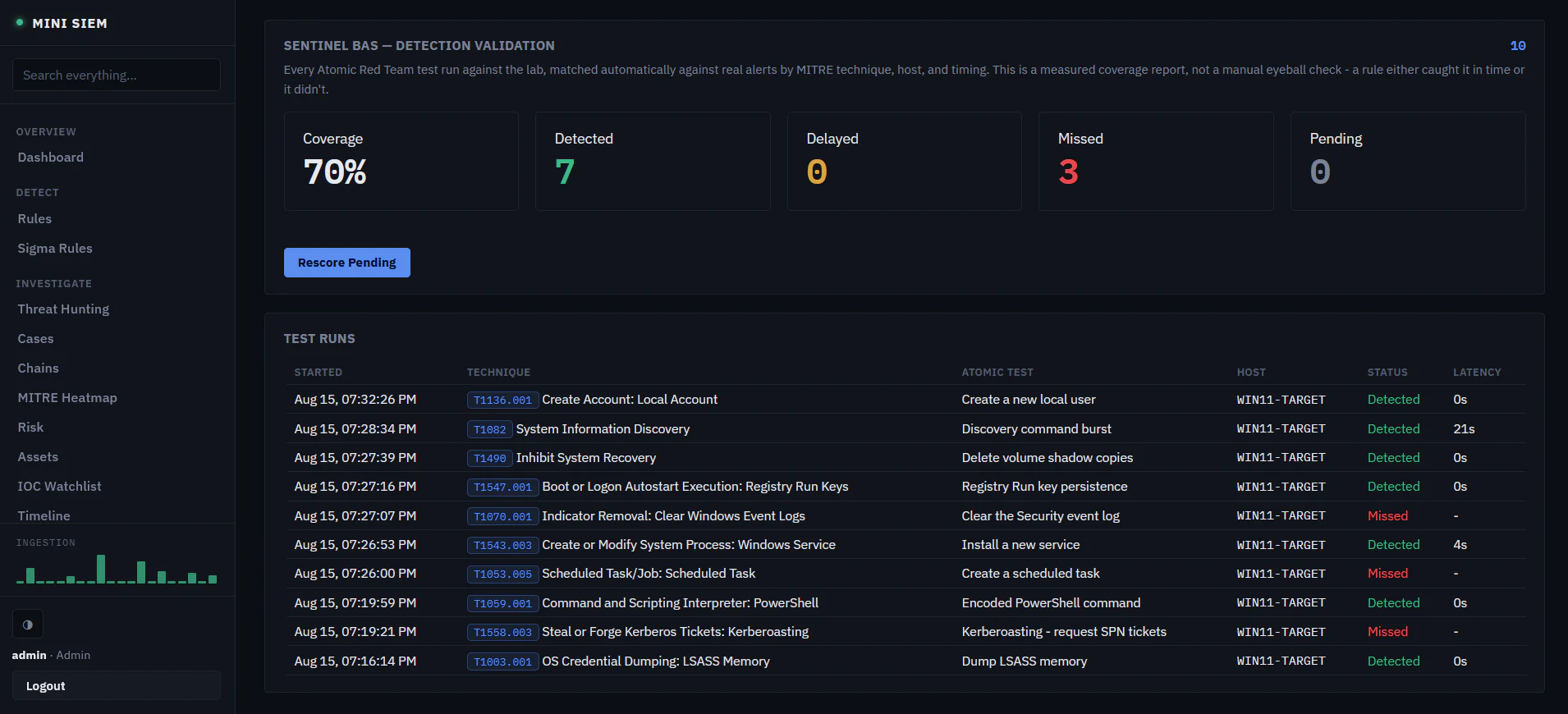
A custom Python SIEM paired with Sentinel BAS to validate detection rules, correlate alerts and investigate missed attack simulations.
Evidence Seven simulations produced matching alerts; three did not. A missing parser field explained the Kerberoasting miss.
Phishing detection
In development
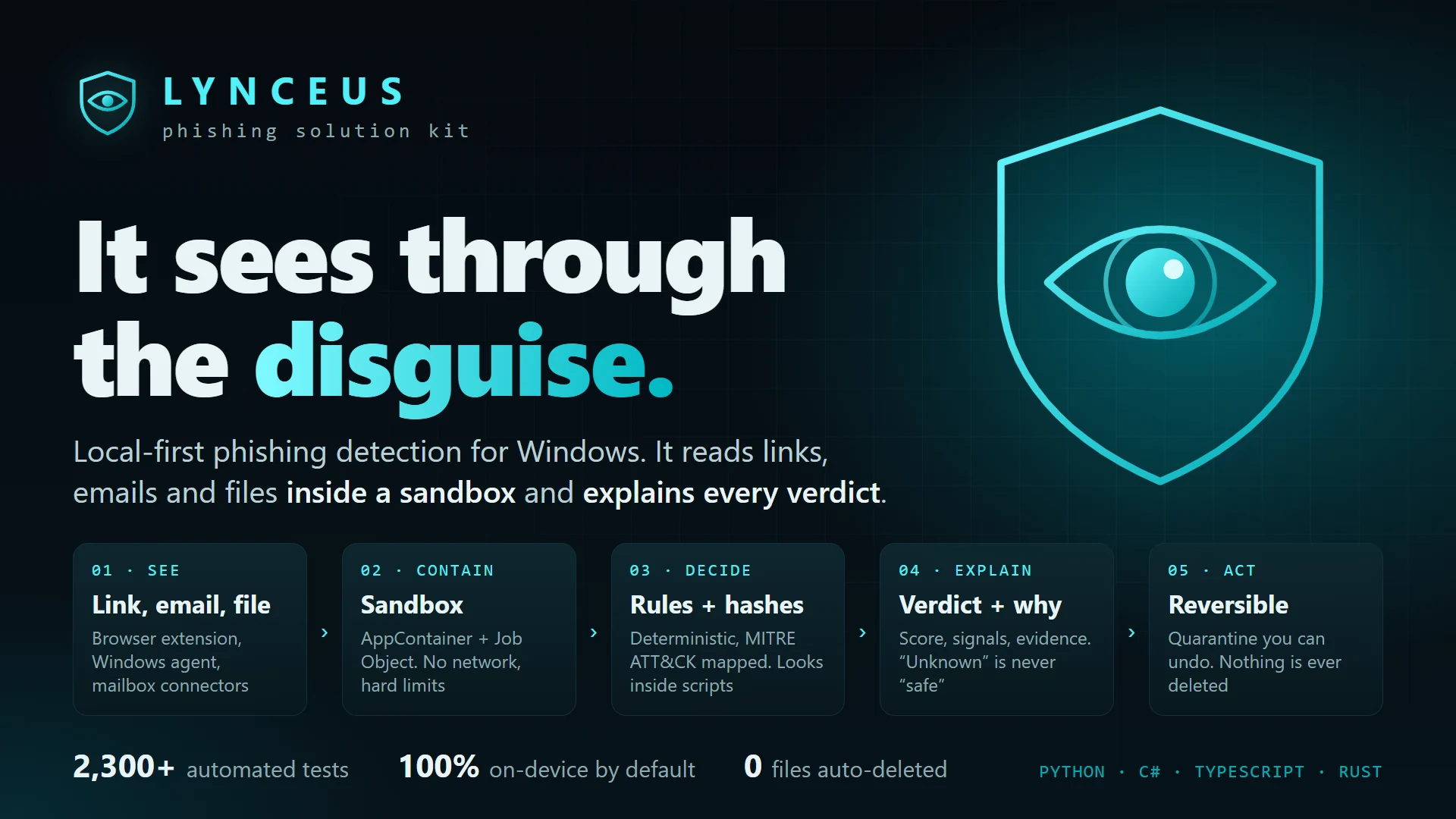
It sees through the disguise.
Local-first phishing detection for Windows. Lynceus reads links, emails, files and, on request, the web page itself inside a sandbox on the user’s own computer, decides with its own rules, file hashes and a learned domain model that can only warn, and explains every verdict: the score, the signals behind it and the evidence. Nothing is sent to an outside service by default, and nothing it quarantines is ever deleted.
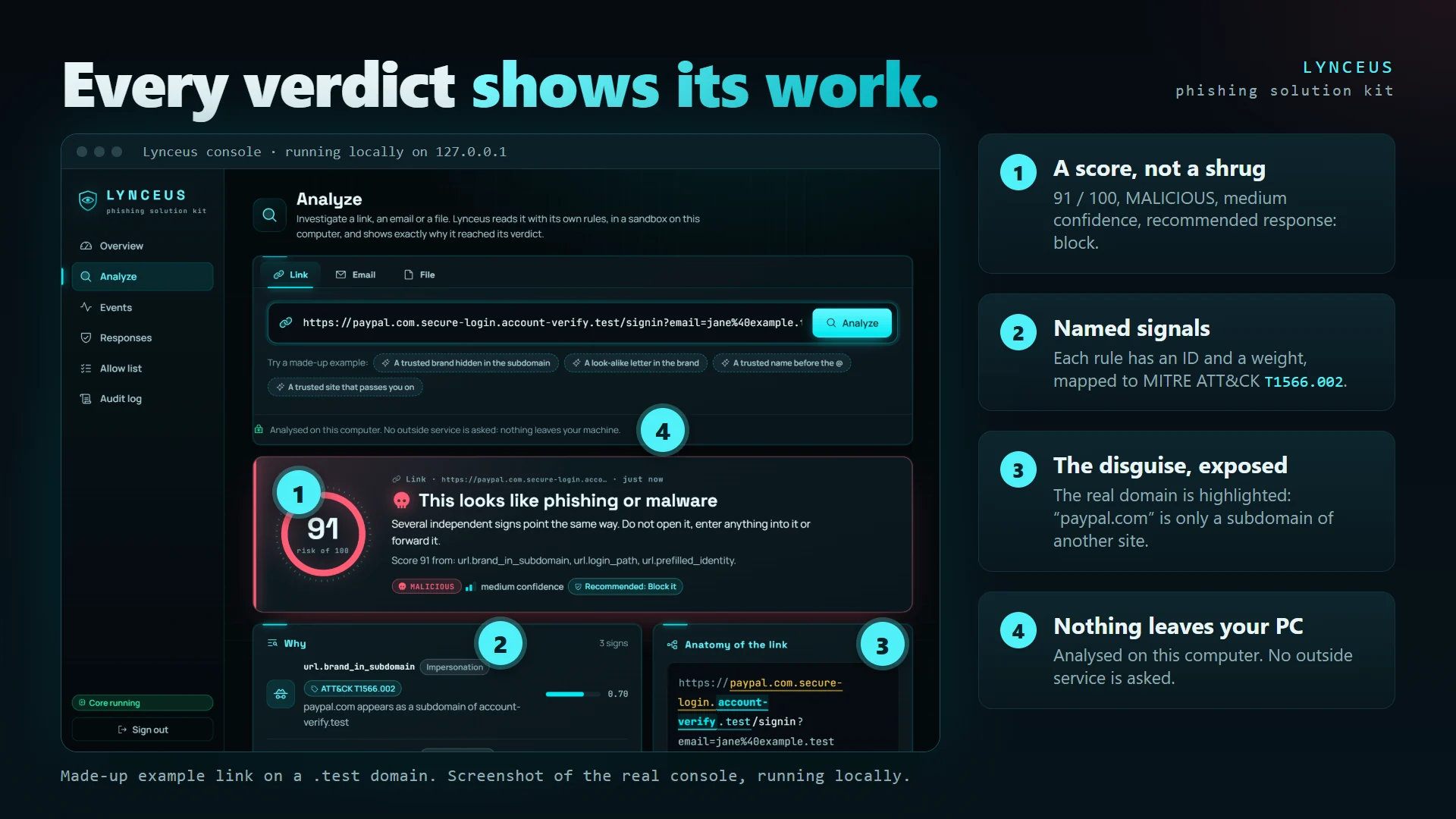
The console runs locally (127.0.0.1) with an Overview, Analyze, Events, Responses, Allow list and Audit log. In the screenshot it analyses a made-up link on a .test domain and answers with a risk score of 91 out of 100, a malicious verdict with medium confidence and a recommended response: block. Below the verdict it names the signals that produced the score, each with its rule ID and weight and mapped to MITRE ATT&CK T1566.002 (spearphishing link), and it takes the link apart to show that “paypal.com” is only a subdomain of another site.
Built withPythonFastAPIC# (.NET 10)TypeScriptReactRust (Tauri 2)PostgreSQLDocker
Lynceus is still being built. The source code is public on GitHub (no license has been chosen yet); the screenshots show the real console running on my computer.
Purple team lab
An isolated Active Directory lab exploring credential abuse, lateral movement and domain compromise, with documented telemetry and defensive analysis.
Evidence Recorded Windows Security, Sysmon and OpenSSH evidence across the attack chain.
Security engineering
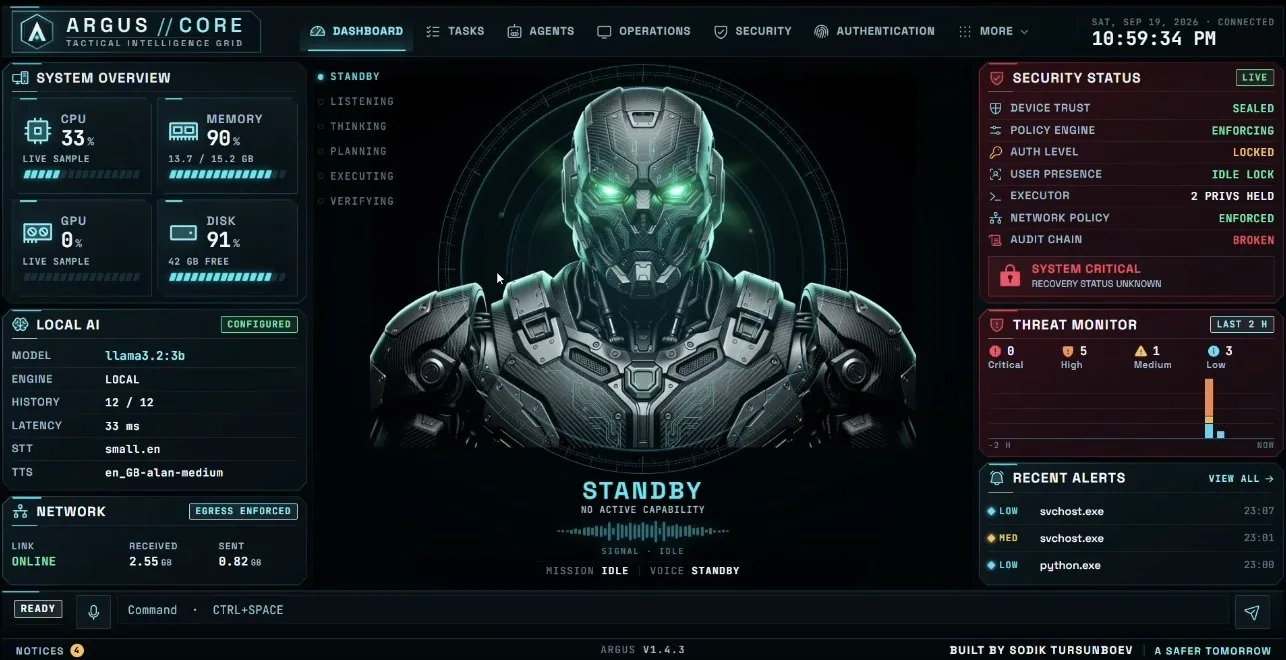
A Windows assistant in active development, combining voice and text interaction, bounded agent workflows and desktop automation with backend authorization controls.
Evidence Public Windows source release with voice, desktop workflows, bounded agents, a 3D state view and documented setup.
Detection evidence
Original screenshots and lab records
Select an original screenshot or lab record to inspect its context and source.
Sentinel BAS matches attack simulations to SIEM alerts and presents the validation results.
Sentinel BAS results. Recorded project screenshot.
I analyze Windows and Linux activity to investigate suspicious behavior and understand its impact.
I work with Splunk and the Elastic Stack (ELK: Elasticsearch, Logstash and Kibana), alongside SIEM, SOAR and EDR tools.
My practical work covers log analysis, phishing and malware investigation, digital forensics and incident response. I correlate events, examine endpoint artifacts and document findings and response recommendations.
My offensive security background includes web application testing (OWASP), Active Directory attack simulation and red teaming. I use that understanding to investigate attacker behavior and evaluate defensive coverage.

Follow each capability to the work or learning evidence behind it.
Developing ARGUS: a Windows assistant that separates model proposals from execution permissions. Its controls and limitations are documented in the case study.
Built Sentinel BAS: connected attack simulations to SIEM alerts and investigated gaps in detection logic.
Engineered a custom Python/Flask SIEM: developed log ingestion, correlation and analyst-approved response workflows.
Built an AD Purple Team lab: traced attack paths and documented the telemetry and defensive findings.
Investigated malware, phishing and ransomware and analyzed security incidents. My practical background also includes web application penetration testing informed by OWASP guidance.
Bachelor’s degree in Computer Engineering
From my first ethical hacking course in November 2023 to the systems I build today.
From the latest entry back to the first course.
Participated in the Digital Forensics and Incident Response track of EC-Council Hackerverse CTF. The participation certificate lists the event level as Master.
Developing ARGUS, a local-first Windows assistant with voice, a Svelte HUD, bounded agents, guarded desktop actions and defensive monitoring.
ARGUS case studyBuilt SODIK OS, a bootable Arch Linux distribution that starts straight into its own cinematic interface.
Read the write-upBuilt a custom SIEM and Sentinel BAS to connect attack simulation, alert correlation and detection validation.
SIEM case studyBuilt an isolated Active Directory lab, reproduced an attack chain from LLMNR poisoning to domain compromise, and documented the resulting telemetry and defensive findings.
Read the write-upFinished 1st in the TryHackMe Sapphire League on 9 February.
Finished both TryHackMe paths in one month: more than 115 hours of attack and defense labs.
Finished 1st in the TryHackMe Gold League on 19 January, then in the Platinum League on 26 January.
Finished the TryHackMe learning path: 30 hours 40 minutes of hands-on labs.
Certified by EC-Council, credential ID ECC5142870936.
Verify credentialCompleted the Certified Ethical Hacker course with EC-Council.
Three courses authorized by Google, on Coursera: Foundations of Cybersecurity, Play It Safe: Manage Security Risks, and Connect and Protect: Networks and Network Security.
See the certificatesMy first ethical hacking course: 16 hours with Zaid Sabih and zSecurity, on Udemy.
Verify certificateCyber Intelligence
From spotting a fake delivery text to Tor and Tails: short lessons at your level, with steps for your own phone or computer.
Select a certificate to view it full size.
Issued by EC-Council, October 2025
Certificate number ECC5142870936
Verify credentialCompleted through EC-Council, July 2025
Certificate number 762648
Verify credentialEC-Council, 3 October 2026 · Master level
Certificate number 2104
Zaid Sabih and zSecurity, on Udemy
November 2023, 16 hours
Verify credentialTechnical write-ups documenting security projects, investigations and findings from testing.
A practical investigation workflow using Windows logs, Sysmon, Process Explorer and Autoruns.
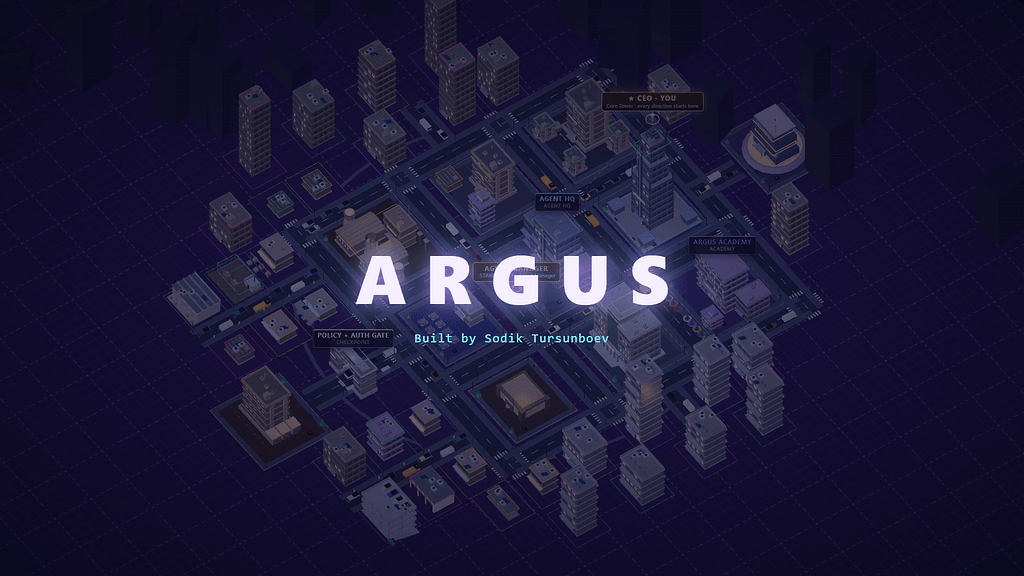
Authorization, integrity checks, sandboxing, and the limits of a Windows AI assistant.
An attack-chain walkthrough in my own lab, with event sources and defensive analysis.
Last curated:
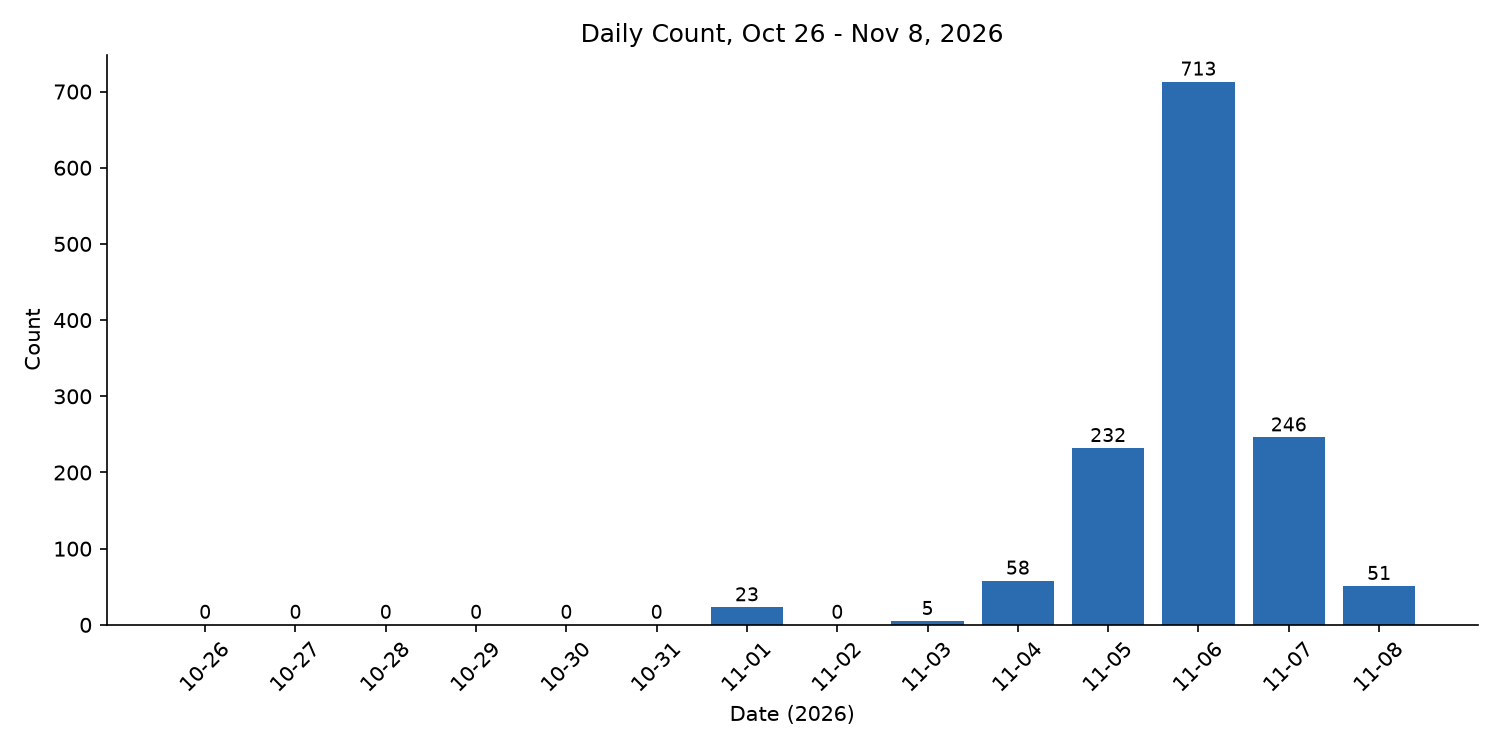 Original publisher image · SANS Internet Storm Center
 Original publisher image · BleepingComputer
 Original publisher image · BleepingComputer
Selected reports from security publishers. Follow each source for the full story. Images belong to the credited publisher.
For project discussions, technical collaboration or questions about my work, contact me by email or through the form below.
Prefer email?
hello@sodik.euDownload CV (PDF)Based in Warsaw, Poland
3D site explorer
A different way around my personal website.